Survey and inventory
Trace existing MDF and IDF connections floor by floor. Identify owner, media, destination, service status and available pathway space without disturbing unidentified live cables.

Keep vertical pathways organized, documented and ready for building changes.
Greater Denver and the Front Range
Products, interfaces and exact scope are confirmed after reviewing the facility.
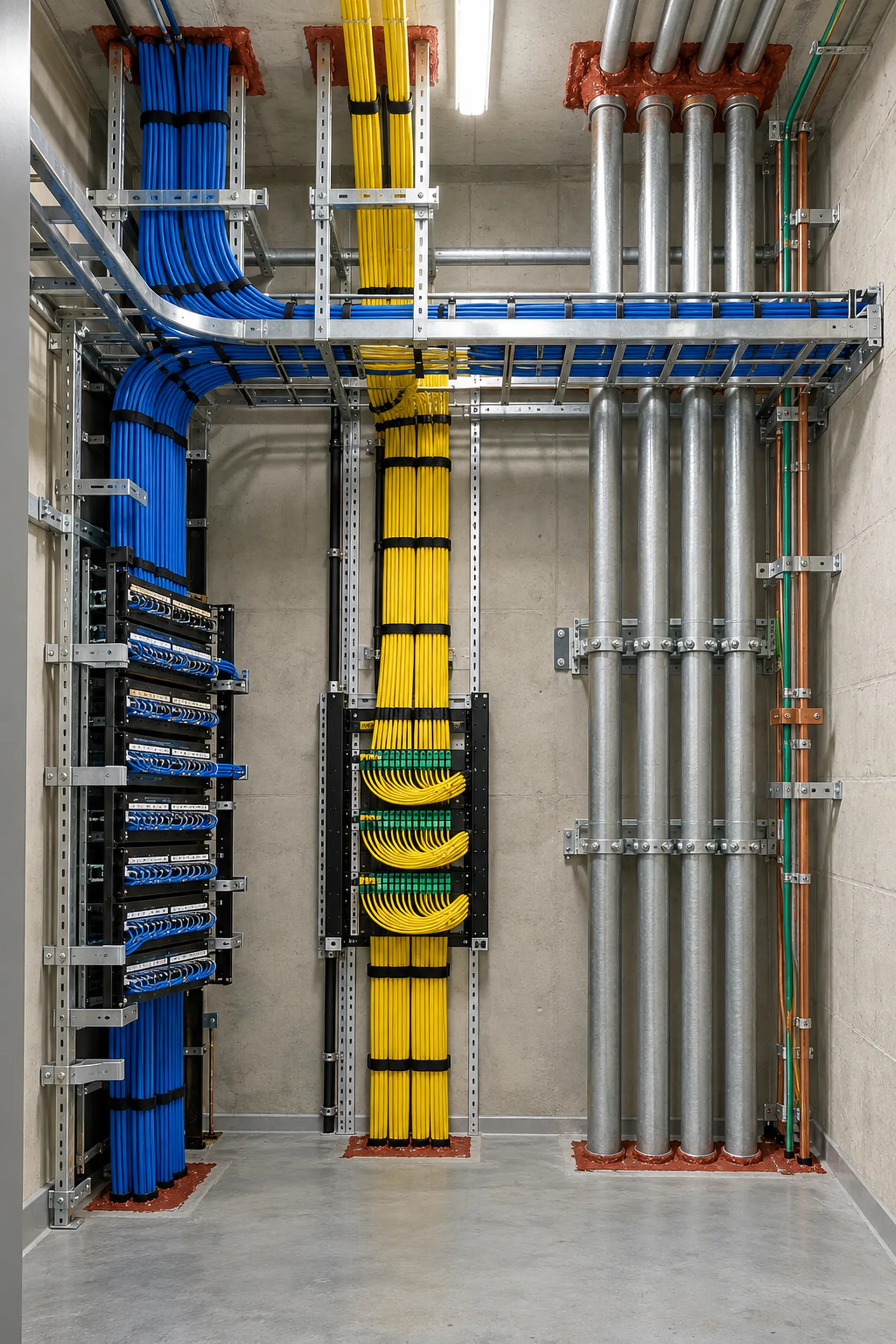
A riser carries different systems and ownership boundaries through an occupied building. We map existing routes, coordinate permitted access and work windows, and distinguish active cable from unidentified or abandoned material before a change.
Inventory each floor-to-floor telecommunications pathway, sleeve, tray, shaft and closet before adding a new run. Coordinate access, firestop responsibility, labeling, capacity, cable ownership and the records that let future trades work safely without disturbing active systems.
Deliver a floor-by-floor pathway record, labeled additions, test results for new media and open issues for the owner and responsible trades.
We confirm existing conditions and customer responsibilities before finalizing products, interfaces, tests and the documentation needed to support the installed system.
A useful design connects components, people, failure conditions and a testable handoff.
Trace existing MDF and IDF connections floor by floor. Identify owner, media, destination, service status and available pathway space without disturbing unidentified live cables.
Review sleeves, trays, rated assemblies, access controls and firestop conditions with the building team and responsible trades. New penetrations and repairs require the applicable approved method.
Plan the work window, route, support method, floor access and service continuity before installing or removing cable. Label at both ends and maintain separation and bend limits for the specified media.
Supply a floor-by-floor riser map, pathway capacity notes, tested new links, ownership and demarcation references, firestop coordination record and a list of unknown or deferred conditions.
Five possible applications to explore during discovery. These describe capabilities and design scenarios, not completed customer projects.
Survey an occupied tower riser and trace active copper, fiber and coax to floor-level demarcations before a tenant build-out.
Coordinate a new fiber backbone through rated floor penetrations with the building team and responsible firestop trade.
Label unidentified telecommunications runs and reconcile closet diagrams against field conditions during a portfolio takeover.
Plan a floor-by-floor cable migration with temporary continuity and approved outages for an operating healthcare facility.
Document spare pathway capacity and ownership boundaries before adding cameras, access controllers and wireless uplinks.
Our pre-site safety review, field documentation and customer acceptance process help keep the installed condition visible to the people who will operate and maintain it. For riser management, the closeout conversation should include: Supply a floor-by-floor riser map, pathway capacity notes, tested new links, ownership and demarcation references, firestop coordination record and a list of unknown or deferred conditions.
We ask for the existing drawings, device inventory, network and power ownership, known deficiencies and the people who will use the system. The final scope and acceptance criteria follow those answers.
| Decision | What to confirm |
|---|---|
| Scope | Confirm the devices, areas and operating modes included in the work; record exclusions. |
| Dependencies | Inventory each floor-to-floor telecommunications pathway, sleeve, tray, shaft and closet before adding a new run. Coordinate access, firestop responsibility, labeling, capacity, cable ownership and the records that let future trades work safely without disturbing active systems. |
| Handoff evidence | Supply a floor-by-floor riser map, pathway capacity notes, tested new links, ownership and demarcation references, firestop coordination record and a list of unknown or deferred conditions. |
Have a building in Colorado? 1st Key stands ready and able to help. Tell us the location and what needs attention; we will confirm service availability and scope.
Describe the facility, the existing equipment and the outcome you need. We can discuss design, deployment or service.