Room and staff workflow
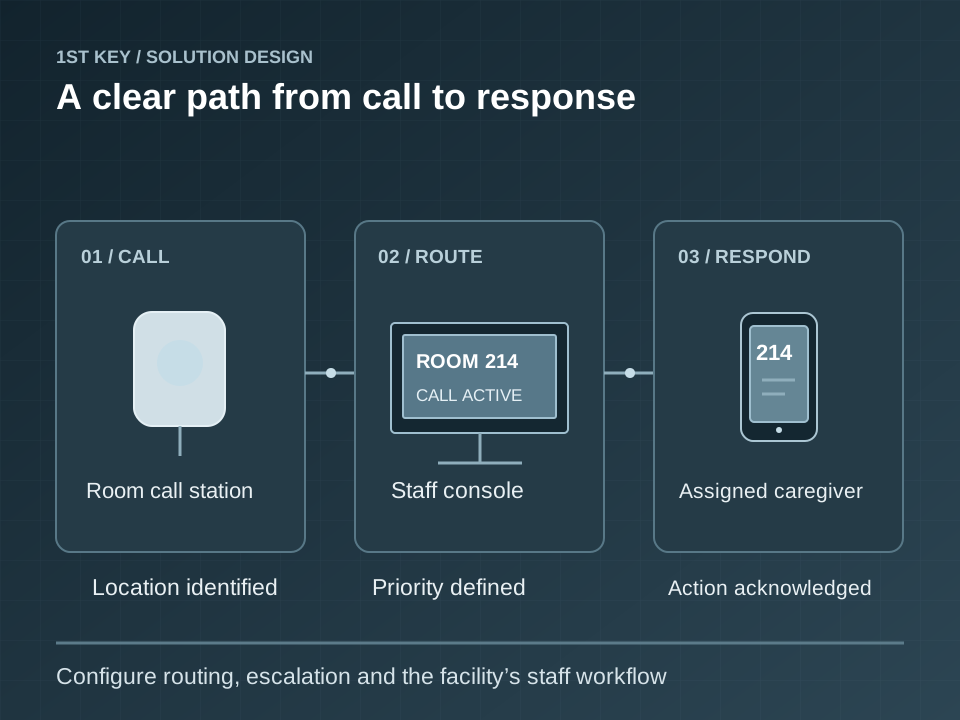
Inventory call points by room and bed, identify the team responsible for each area and define normal, assistance and priority calls using the selected platform’s supported configuration.

Connect patient and resident calls to a clear acknowledgment, communication and escalation workflow.
Greater Denver and the Front Range
Products, interfaces and exact scope are confirmed after reviewing the facility.
Define the care team’s workflow before selecting endpoints. Review room identifiers, staff assignments, alert priorities, network and power dependencies, and the integrations supported by the selected manufacturer.
Walk the call from the room to the responsible staff member. Confirm station identification, call priority, acknowledgment, escalation and restoration after loss of power or connectivity against the facility’s approved workflow.
Provide a room-by-room station list, call-routing settings, test records and staff orientation using the workflows approved by the facility.
We confirm existing conditions and customer responsibilities before finalizing products, interfaces, tests and the documentation needed to support the installed system.
A useful design connects components, people, failure conditions and a testable handoff.
Inventory call points by room and bed, identify the team responsible for each area and define normal, assistance and priority calls using the selected platform’s supported configuration.
Map each call to its console, corridor indicator or supported mobile recipient. Decide how it is acknowledged, escalated and cleared under the facility’s approved care workflow.
Coordinate cable pathways, power, network requirements, backup arrangements and manufacturer-supported interfaces. Record who administers each connected system and its permissions.
Place test calls from each covered endpoint, verify room identification and routing, and document exception handling and restoration. Train staff with the scenarios they will use during a shift.
Five possible applications to explore during discovery. These describe capabilities and design scenarios, not completed customer projects.
Map resident room and bathroom call points for an assisted-living renovation.
Review staff assignments and call routing before expanding an existing care unit.
Modernize stations in phases while coordinating temporary coverage with the facility team.
Evaluate a supported mobile alert interface against the care team’s acknowledgment process.
Create room-by-room test records and practical staff orientation for a newly installed system.
Our pre-site safety review, field documentation and customer acceptance process help keep the installed condition visible to the people who will operate and maintain it. For nurse call, the closeout conversation should include: Place test calls from each covered endpoint, verify room identification and routing, and document exception handling and restoration. Train staff with the scenarios they will use during a shift.
We ask for the existing drawings, device inventory, network and power ownership, known deficiencies and the people who will use the system. The final scope and acceptance criteria follow those answers.
That depends on the selected platform, supported interfaces and the facility’s workflow. We review recipient assignments, acknowledgment, escalation and support ownership before proposing an interface.
A phased approach needs a survey of the installed platform and a continuity plan approved by the facility. Equipment compatibility, temporary coverage and testing requirements shape the proposed phases.
| Decision | What to confirm |
|---|---|
| Scope | Confirm the devices, areas and operating modes included in the work; record exclusions. |
| Dependencies | Walk the call from the room to the responsible staff member. Confirm station identification, call priority, acknowledgment, escalation and restoration after loss of power or connectivity against the facility’s approved workflow. |
| Handoff evidence | Place test calls from each covered endpoint, verify room identification and routing, and document exception handling and restoration. Train staff with the scenarios they will use during a shift. |
Have a building in Colorado? 1st Key stands ready and able to help. Tell us the location and what needs attention; we will confirm service availability and scope.
Describe the facility, the existing equipment and the outcome you need. We can discuss design, deployment or service.